
Introduction
Untreated or poorly filtered cooling water doesn't announce itself quietly. Suspended solids, corrosion byproducts, scale-forming minerals, and biological debris build up gradually. By the time you notice reduced heat-transfer performance, you're already behind on maintenance. In mission-critical facilities, that lag can translate into unplanned downtime.
Here's the challenge: there is no single "best" cartridge. The right choice depends on your loop type, contaminant load, required flow, allowable pressure drop, water chemistry, and OEM equipment requirements. A cartridge rated for drinking water won't necessarily hold up in a 1,500-gpm condenser loop.
This guide breaks down five cartridge categories used in data center cooling, the criteria that actually matter when selecting one, and where filtration fits within a broader water-treatment program.
TL;DR
- Match cartridge to duty: sediment/pleated for particles, high-flow for volume, carbon or specialty only for defined chemistry.
- Verify before buying: flow, micron rating, pressure drop, compatibility, housing fit, and replacement supply.
- Never use drinking-water cartridges or treat filtration as a fix for scale, corrosion, or microbes.
- Confirm test basis and conditions before you compare manufacturer performance claims.
Overview of Water Filter Cartridges in Data Center Cooling Systems
A water filter cartridge is a replaceable filtration element installed inside a housing or side-stream assembly. Its job is to remove targeted suspended or dissolved contaminants from cooling or make-up water before they reach heat exchangers, coils, or plate assemblies.
Where Cartridges Fit in a Cooling System
Data center cooling water shows up in three main contexts, and each calls for a different filtration strategy:
- Closed chilled-water loops — cartridges here typically target corrosion products, particulates, and construction debris while preserving system chemistry.
- Open cooling-tower or condenser-water systems — filtration is usually one piece of a side-stream strategy that also includes blowdown, biocide dosing, and corrosion/scale control.
- Make-up or pre-treatment water — sediment, carbon, or membrane prefiltration gets selected based on the incoming-water analysis, not guesswork.

ASHRAE Technical Committee 9.9 stresses site-specific plans for corrosion, fouling, scaling, and microbial control in facility-water loops. Supply-side filtration is specifically called out as necessary to prevent sediment from fouling heat-transfer surfaces in water-cooled datacom equipment.
The same guidance notes that endpoint filtration on a CDU's supply side protects plate heat exchangers from particulate buildup.
What actually matters operationally:
- Stable flow and acceptable pressure drop across the cartridge's service life
- Reduced fouling risk at heat exchangers and coils
- Manageable maintenance intervals, not surprise emergency changeouts
- Support for continuous uptime in mission-critical environments
"Best" filtration, then, means best fit for a defined water-quality duty. That's the frame for the rankings below.
Top 5 Water Filter Cartridges for Data Center Cooling Systems
Before ranking anything, weigh each option against these criteria:
- Contaminant target — what are you actually trying to remove?
- Flow capacity — does it match your loop's gpm requirement?
- Pressure-drop behavior — clean and terminal DP, not just one number
- Media and housing compatibility — chemical, temperature, and connection fit
- Service life and monitoring — how will you know when it's time to change it?
- Documented performance and TCO — test data, changeout cost, and housing labor over a full service year
1. Pleated Polypropylene Sediment Cartridge — Best for Particulate Removal
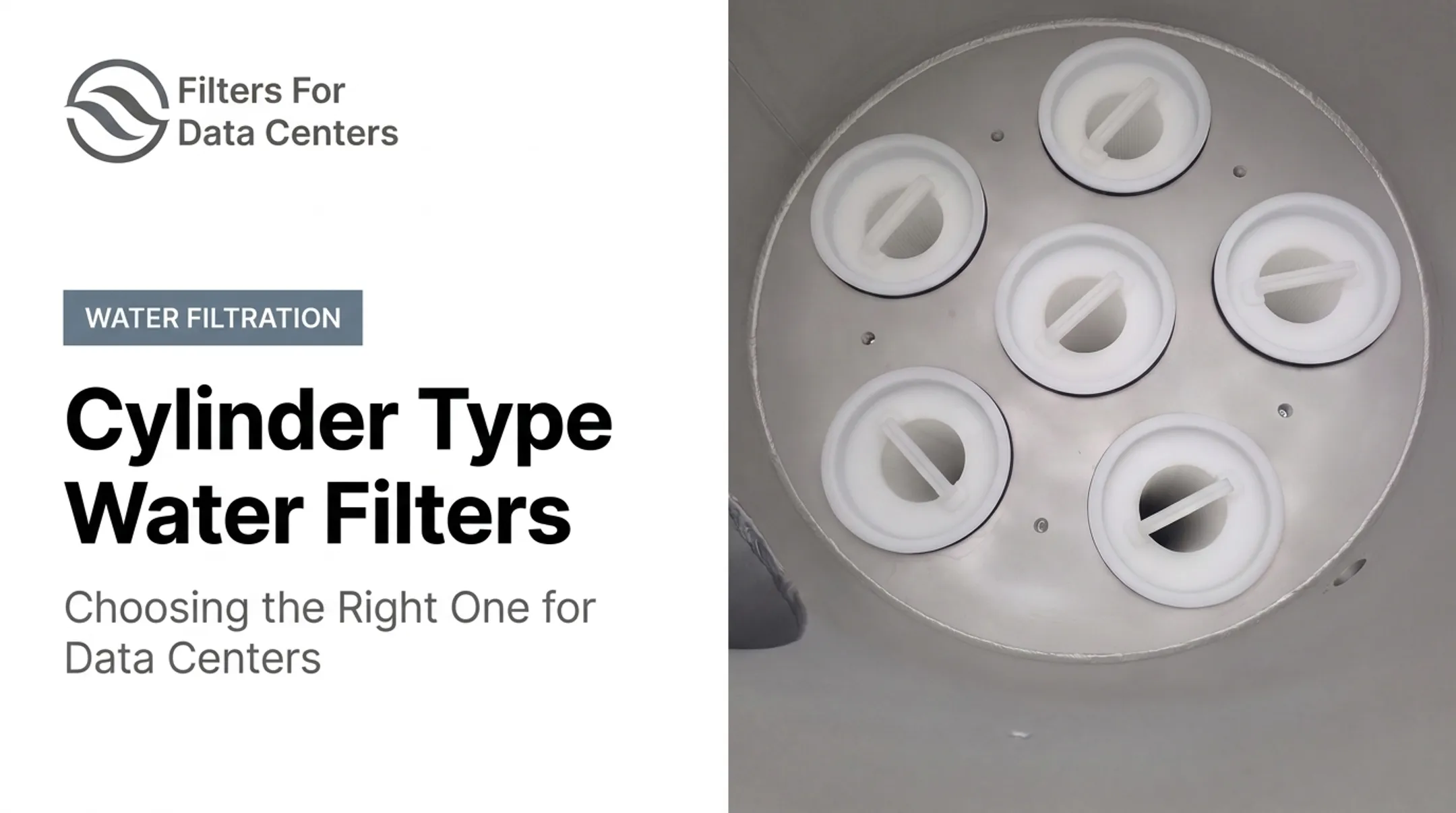
Pleated media packs more surface area into the same cartridge footprint compared to standard depth media, which means it can capture more suspended solids and corrosion debris before pressure drop climbs.
Manufacturer data varies significantly by product line. Parker's Claripor line, for example, lists absolute retention around 99.98%, micron options from 0.5 to 90 µm, a recommended changeout near 35 psid, and a maximum temperature of 176°F at 30 psid.
Pentair's Pureflex line claims similar absolute efficiency at Beta 5000 but publishes less detailed pressure-drop data.
Best for: systems with moderate-to-heavy particulate loading and where cartridge changeouts are relatively frequent.
Watch for: neither product line above is explicitly qualified for cooling-water service—confirm wetted-material compatibility and actual clean-DP curves for your chemistry before ordering.
2. Melt-Blown or Depth Sediment Cartridge — Best for Economical Prefiltration
Depth filtration works well as a first-stage defense against sand, rust, silt, and general particulate loading. Performance, though, swings widely based on construction.
Eaton's LOFTREX cartridge, for instance, is rated at 80% efficiency across 1 to 75 µm options, with a maximum DP of 29 psid at 70°F and a recommended changeout around 26 psid.
Pall's Claris melt-blown cartridge runs a max DP of 50 psid at 68°F, dropping to 25 psid at 140°F, with changeout recommended near 35 psid.
Key comparison points:
- Dirt-holding capacity (ask for loading curves, not just marketing claims)
- Flow restriction as the cartridge accumulates solids
- Compatibility with your existing housing
- Suitability for continuous versus side-stream service
Donaldson lists cooling towers among applications for its PP melt-blown line, but doesn't publish a numeric dirt-holding benchmark in its public documentation. Get application-specific test data rather than assuming a generic capacity figure applies to your loop.
3. High-Flow Cartridge — Best for Large-Volume Side-Stream Applications
When a system needs to move hundreds of gallons per minute through a side-stream, standard 10-inch cartridges become impractical fast. You'd need dozens of housings just to keep up.
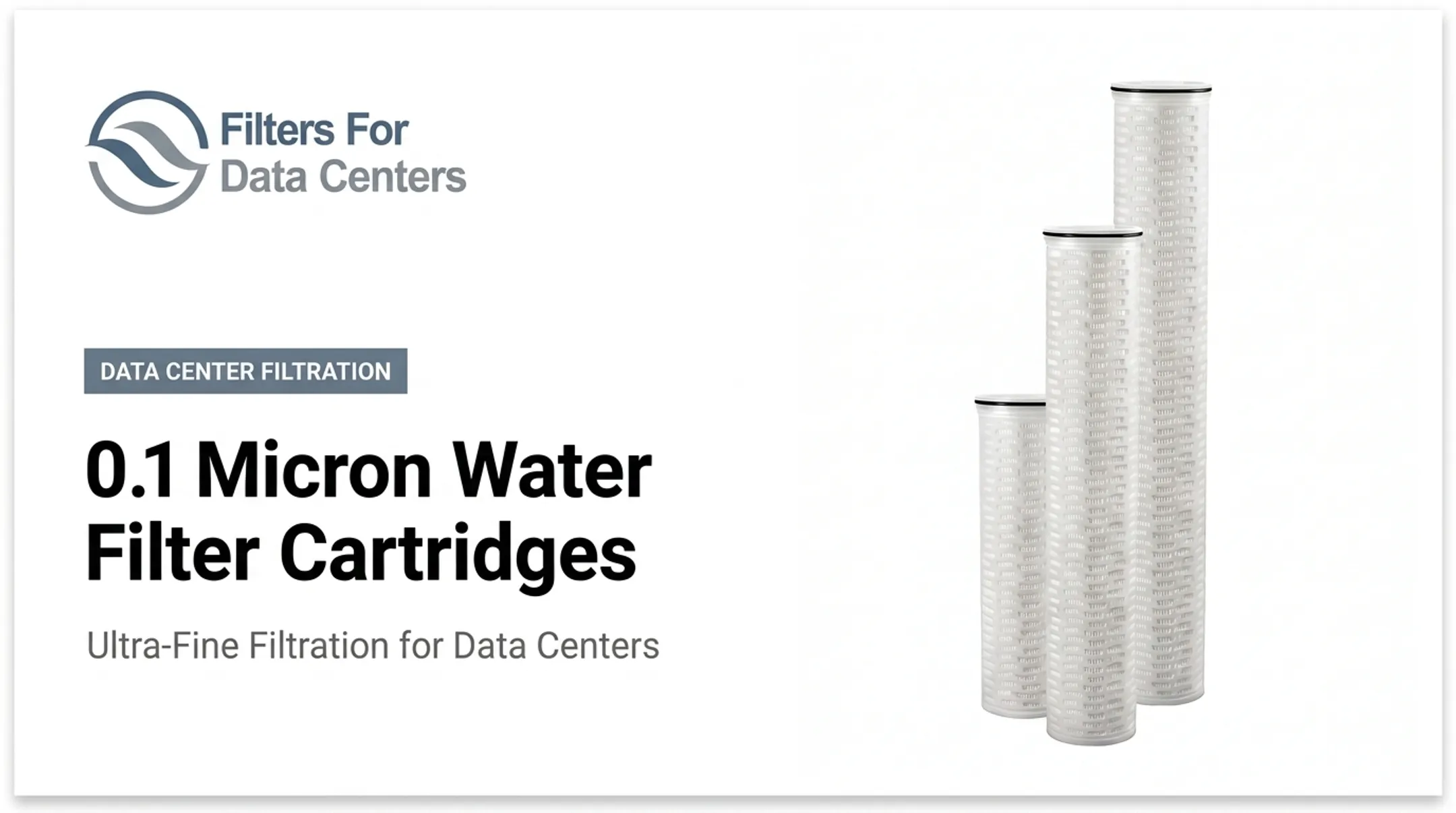
High-flow cartridges solve this by packing significantly more filtration area into a single large-diameter element. Data Center Filters carries this category directly. Typical specs below show what to evaluate regardless of brand:
| Specification | Typical Value |
|---|---|
| Particle rating range | 0.5–100 µm |
| Filtration area (20-inch length) | ~25 sq. ft. |
| Cartridge lengths | 20", 40", 60", 80" |
| Outer diameter | 6" (152 mm) |
| Max operating DP | 60 psi at 70°F; 35 psi at 176°F |
| Recommended changeout DP | 30 psi |
| Seal options | EPDM, E-FKM, FKM, silicone |
| Construction | Polypropylene, inside-to-outside flow |
At a 40-inch cartridge length, clean pressure drop at 100 gpm runs roughly 2.4 psi for a 0.5-µm rating down to about 0.06 psi at 100 µm. Micron selection has a real, measurable effect on hydraulics.
One large-format cartridge can replace duties otherwise requiring several conventional 10-inch elements, which cuts down on housing count, changeout labor, and inventory.
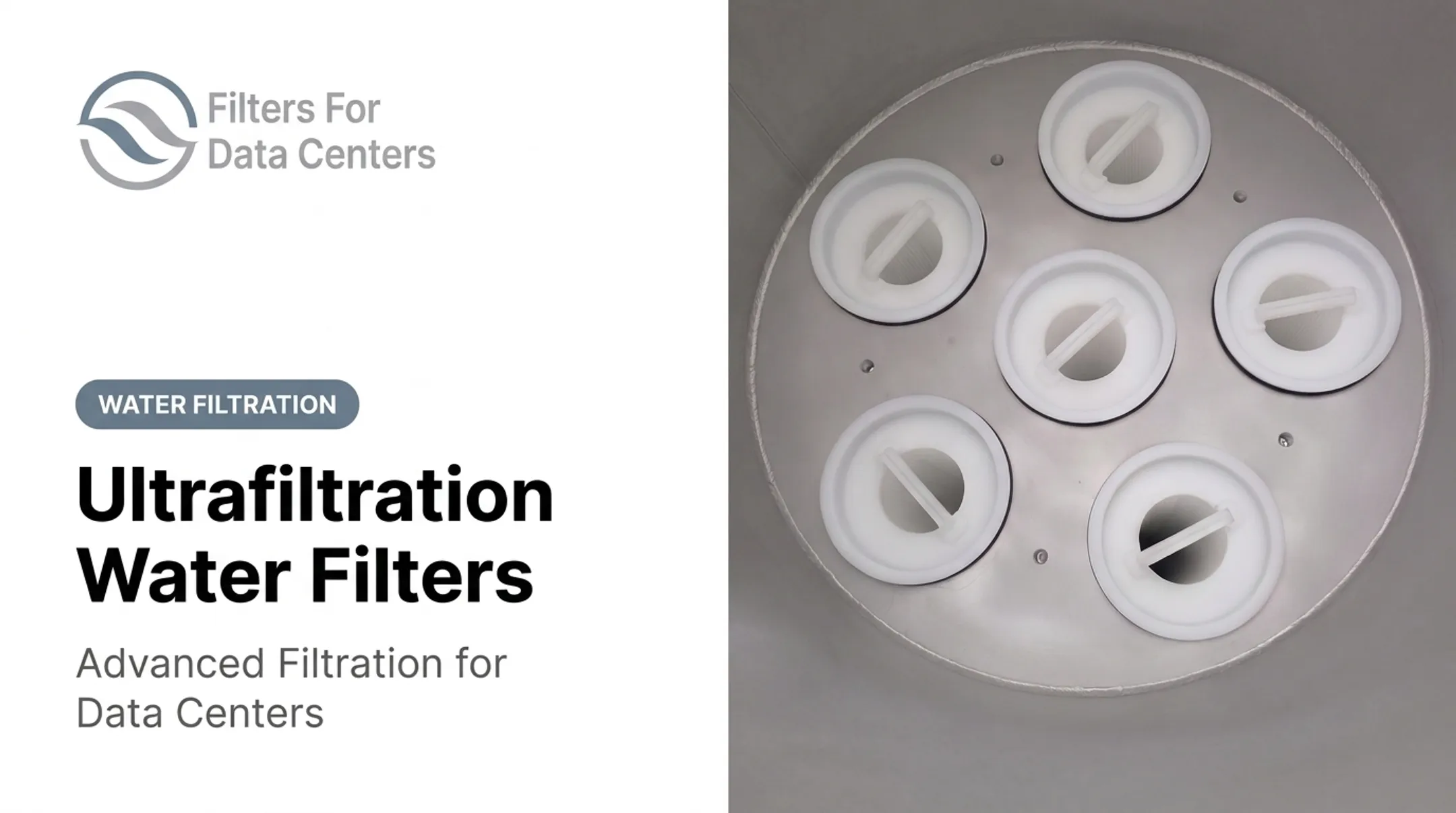
ClearFlow-brand high-flow housings, as one industry example, accommodate 1 to 16 cartridges with connections up to 12 inches. They can also be skid-mounted with an integrated pump and flowmeter.
Best for: large chilled loops, cooling-tower side-streams, or make-up water pretreatment where footprint and changeout frequency matter as much as raw filtration performance.
Watch for: absolute-rated (HF98) configurations run roughly 5-10% higher differential pressure than standard absolute-rated cartridges, while nominal and high-efficiency versions run 15-20% lower. Choose based on your actual DP budget, not just the finest available rating.

4. Activated-Carbon Cartridge — Best for Targeted Organic or Chlorine Reduction
Carbon media isn't a universal cooling-loop filter, and treating it that way can backfire. If your facility relies on corrosion inhibitors or biocides, carbon can strip those chemicals right along with the contaminants you're trying to remove.
Ergil's cooling-water-return carbon system makes this risk explicit in its own marketing: the system is designed specifically to remove residual biocides, corrosion inhibitors, oils, and hydrocarbons from closed-loop water. That's a direct signal that carbon polishing changes water chemistry, not just clarity.
Before specifying activated carbon, confirm:
- Exact contaminant claims (chlorine, chloramine, specific organics)
- Contact time (EBCT)—industry guidance suggests 8-10 minutes for toxic organics
- Flow limitations relative to bed depth
- Whether it will interact with your existing chemical-treatment program
Best for: incoming make-up water with known chlorine, chloramine, or organic issues—not general cooling-loop duty.
5. Specialty Scale-Control or Chemical-Compatible Cartridge — Best When Water Analysis Justifies It
Scale-control, ion-exchange, or specialty resin cartridges belong in the conversation only when a documented water-chemistry problem calls for them. They're not a substitute for a full cooling-water treatment program.
Watts' OneFlow system, which uses Template Assisted Crystallization rather than ion exchange, shows how narrow these windows can be. It is designed for feed water between 41-100°F and pH 6.5-8.5.
It should not be used in closed circuits, low-flow conditions, or standing water, and it doesn't address silica scaling.
Best for: a narrowly defined chemistry issue confirmed by water testing—not as a general-purpose upgrade.
Comparison at a Glance
| Category | Best Application | Principal Limitation | Maintenance Approach |
|---|---|---|---|
| Pleated polypropylene | Moderate-to-heavy particulate loading | Not inherently cooling-water qualified | DP-triggered changeout |
| Melt-blown/depth | Economical prefiltration | Performance varies widely by brand | DP-triggered changeout |
| High-flow | Large-volume side-stream/make-up | Requires adequate supply pressure | DP-triggered, fewer changeouts |
| Activated carbon | Chlorine/chloramine/organic reduction | Can strip treatment chemicals | Breakthrough monitoring |
| Specialty scale-control | Documented chemistry problem only | Narrow operating window | Manufacturer-specific interval |
How We Chose the Best Water Filter Cartridges
Every recommendation above starts with water analysis and a system schematic. Before selecting anything, identify whether the cartridge will treat closed-loop water, tower/condenser water, make-up water, or a dedicated side stream. Skipping this step is the single most common selection mistake we see.
Technical Fit Checks
- Match micron rating to documented contaminant load, not the most impressive-sounding number
- Confirm flow, housing space, connection type, max DP, temperature range, and pH range
- Check compatibility with glycol, corrosion inhibitors, and biocides already in the system
- Review manufacturer test data and certifications for industrial cooling-water service, not drinking-water use
Nominal and absolute ratings use different test bases. Pall's filtration guidance treats a nominal rating as a manufacturer-set weight-percent removal figure, so two "5-micron" cartridges from different brands can perform very differently.
Operational Fit Checks
Sizing a side-stream filter isn't just about the cartridge. The DOE/PNNL report on cooling-tower side-stream filtration recommends sizing these systems at 3–10% of total system flow, sometimes up to 20%. For a 1,500-gpm loop, that is roughly 150 gpm through the side stream alone.
The same report notes that side-stream systems typically need 20–30 psi of supply pressure to overcome filter-medium pressure drop. That often means adding a dedicated pump.
Total cost of ownership should factor in:
- Cartridge and housing purchase cost
- Labor for changeouts (frequency matters more than unit price)
- Disposal requirements
- Downtime risk if a bypass or DP alarm isn't in place
Common Selection Mistakes
- Treating a cartridge as the only water-treatment method
- Ignoring pressure-drop alarms until flow visibly drops
- Skipping bypass protection, which risks unfiltered water reaching equipment
- Using media incompatible with existing treatment chemicals
- Letting exhausted cartridges stay in service past their changeout DP
Quick recommendation framework:
- High sediment load → pleated or melt-blown sediment cartridge
- Large flow volume → high-flow cartridge
- Chemical-sensitive loop → verify compatibility before choosing any media, especially carbon
- Poor incoming water quality → pretreatment sediment or carbon, based on lab analysis
- Specific chemistry problem (scale, hardness) → specialty cartridge, only after testing confirms the need

If lab results show overlapping issues, or you are unsure how a cartridge will interact with your existing treatment program, bring in a qualified water-treatment engineer before you buy.
Conclusion
The best water filter cartridge for your data center cooling system is the one that matches your water chemistry, flow requirements, contaminant profile, and equipment constraints, backed by a maintenance plan you'll actually follow. Micron rating alone doesn't tell the whole story.
Before you buy, validate the choice against:
- Actual water testing results
- Differential-pressure and flow data
- Cooling equipment OEM requirements
- Your facility's scale, corrosion, and biological-control program
Cooling-water filtration covers the liquid side. Airborne debris is the other exposure: cottonwood, dust, insects, leaves, and similar contaminants at external intakes.
Data Center Filters' AFF Field Services team supports that risk with custom intake filtration and on-site installation, as a complement to your cooling-water program, not a replacement for it.
Frequently Asked Questions
What is the best drinking water filter to buy?
The answer depends on your specific drinking-water contaminant and use case. Don't transfer that recommendation to a data center cooling loop without confirming industrial flow, chemistry, and equipment requirements first.
What are the top five water filters?
For data center cooling, the relevant categories are pleated sediment, melt-blown/depth sediment, high-flow, activated-carbon, and specialty chemistry-compatible cartridges. The best option depends on your application. There's no universal winner.
What type of cartridge is best for a cooling tower?
Side-stream filtration matched to your suspended-solids load, required flow, and pressure drop works best. Coordinate it with blowdown, scale, corrosion, and microbiological treatment rather than relying on filtration alone.
Is a lower micron rating always better for cooling-water filtration?
No. Finer filtration increases pressure drop and shortens service life. Select the rating based on water testing, contaminant targets, and pump capacity, not simply the smallest number available.
How often should cooling-water filter cartridges be replaced?
Replacement depends on differential pressure, flow loss, water quality, and cartridge capacity. Monitor differential pressure performance instead of relying on a fixed calendar schedule.