
Condenser water quality plays a direct role in this equation. The DOE Federal Energy Management Program identifies fouling, scaling, and corrosion as the primary treatment concerns in cooling-tower systems, each capable of reducing tower efficiency over time.
This guide separates two things that often get lumped together: condenser-water filtration and treatment on the water side, and external air-intake filtration that protects coils, fans, and outdoor equipment. We'll cover how the condenser-water loop works, where contamination risks originate, how filtration approaches compare, and what to look for when selecting and maintaining a system built for mission-critical uptime.
Key Takeaways
- Condenser water moves chiller heat to the tower; dirty water and airborne debris both threaten that path.
- Water filtration, strainers, chemistry, and air-intake filters each solve different problems—none replaces the others.
- Favor redundancy, low-disruption service, and pressure-drop monitoring over any single filter rating.
- Match the strategy to tower design, water chemistry, local debris load, and uptime requirements.
How Condenser Water and Cooling Towers Work Together
Condenser water is the loop that carries heat away from a water-cooled chiller's refrigerant condenser and delivers it to a heat-rejection device, typically a cooling tower.
Chilled water and condenser water do opposite jobs. Chilled water absorbs heat from the data center's IT load. Condenser water carries that heat—plus the compressor's heat of compression—out to the atmosphere.
The Condenser-Water Loop, Step by Step
Water leaves the tower basin, gets pushed by the condenser-water pump through the chiller's condenser, picks up heat from the refrigerant, and returns to the top of the tower. There it's distributed over the fill while fans pull or push air through the same space.
A portion of the water evaporates, and that evaporation is what actually removes the heat. The remaining water drops into the basin several degrees cooler and heads back to the chiller.
A handful of components keep this cycle running:
- Basin: collects returning water and holds the reserve volume the pump draws from
- Fill: maximizes water-to-air contact surface for evaporation
- Spray nozzles: distribute water evenly across the fill
- Fans: move air through the tower via induced draft (pulling) or forced draft (pushing)
- Makeup water and blowdown: replace evaporated water and flush out concentrated minerals
- Drift eliminators: catch water droplets before they exit with the air stream

Crossflow vs. Counterflow, Forced vs. Induced Draft
Tower configuration shapes airflow—and how easy the system is to keep clean:
- Crossflow: air moves horizontally across falling water; hot-water basin with gravity-fed nozzles
- Counterflow: air moves upward against falling water; pressurized header and branch arms
The layout affects more than airflow. It also sets how much access you have for filtration and debris removal, and how exposed the fill and nozzles are to windblown material.
Draft direction matters too:
- Induced draft: better resistance to air recirculation; lower total static pressure; more sensitive to clogged inlets
- Forced draft: tolerates more external static pressure; somewhat more exposure to recirculated warm air
When the Tower Struggles, the Chiller Pays the Price
None of this happens in isolation. If the tower can't reject heat efficiently, condenser water returns to the chiller warmer than design conditions call for. That raises condensing temperature and pushes additional demand onto the chiller, up to its design limits.
Fouled fill or blocked airflow drives that warmer return temperature. The result is higher chiller energy use and less available cooling capacity.
Why Filtration Matters in Data Center Cooling Systems
Two very different contamination problems threaten cooling performance, and treating them as one is where maintenance budgets go sideways.
Airborne Debris Around Outdoor Cooling Equipment
Cooling towers, condensers, and outdoor coils sit exposed to whatever the local environment produces: dust, pollen, cottonwood fluff, leaves, insects, construction debris. None of it belongs on a heat-transfer surface.
When that debris builds up, performance slips even though every mechanical component is technically fine:
- Dust and pollen mat against coil fins and fill
- Insects and leaves plug nozzles and screens
- Airflow paths narrow and fans work harder
- Heat transfer drops under the same load
Water-Side Contamination Is a Separate Problem
Suspended solids, biological growth, corrosion byproducts, and scale build up inside the condenser-water loop itself—a completely different failure path from airborne debris.
Research published in ASHRAE Journal on condenser-tube fouling found that mineral deposits from calcium and magnesium ions on enhanced condenser-tube surfaces reduce heat-transfer performance and increase water-side pressure drop.
Left unmanaged, fouled fill, plugged strainers, blocked nozzles, and dirty coils compound each other:
- Fan energy climbs
- Pump strain increases
- Cleaning cycles get more frequent
- Labor cost and unplanned thermal-event risk rise together

Filtration Doesn't Replace Legionella Controls
Mechanical filtration removes suspended particles. It does not disinfect water or eliminate Legionella risk on its own.
CDC's Legionella control guidance for cooling towers treats filtration for suspended solids as one part of a broader program, not a substitute for any of these:
- Routine water-parameter monitoring
- Automated blowdown
- Drift elimination
- Scheduled disinfection
Work with a qualified water-treatment professional and follow current CDC, EPA, and applicable industry guidance rather than relying on filtration alone.
Pulling air-intake filters out entirely, or oversizing them past what the fan can handle, trades one risk for another. Excess pressure drop restricts airflow just as effectively as the debris you were trying to keep out.
Filtration Approaches for Cooling Tower and Condenser-Water Systems
Once you know what's fouling the system, matching a filtration method to it becomes straightforward.
Matching Filter Type to the Contaminant
- Coarse screens and basin strainers: catch leaves, insects, and large debris at the basin inlet
- Simplex strainers: single-basket units with removable 316 stainless-steel baskets (1/32 to 3/4 inch or 20 to 400 mesh); brief flow interruption during cleaning
- Duplex strainers: dual-chamber units that isolate one basket for cleaning while the other stays online
- Automatic self-cleaning filters: screen, disc, or sand-media units that backwash without stopping flow
- Bag and cartridge filters: sidestream or full-flow elements for finer removal, typically 0.5 to 100 microns
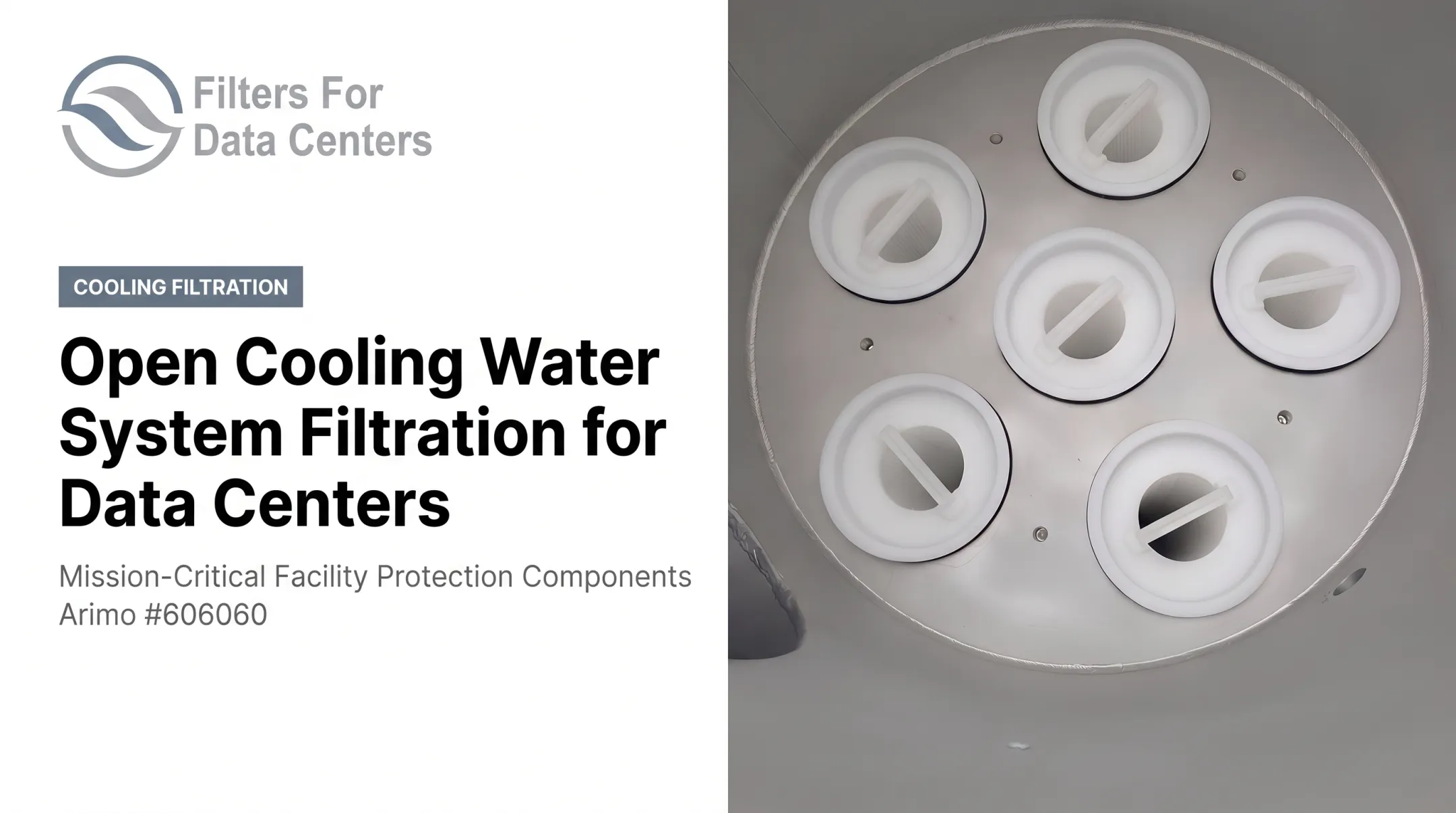
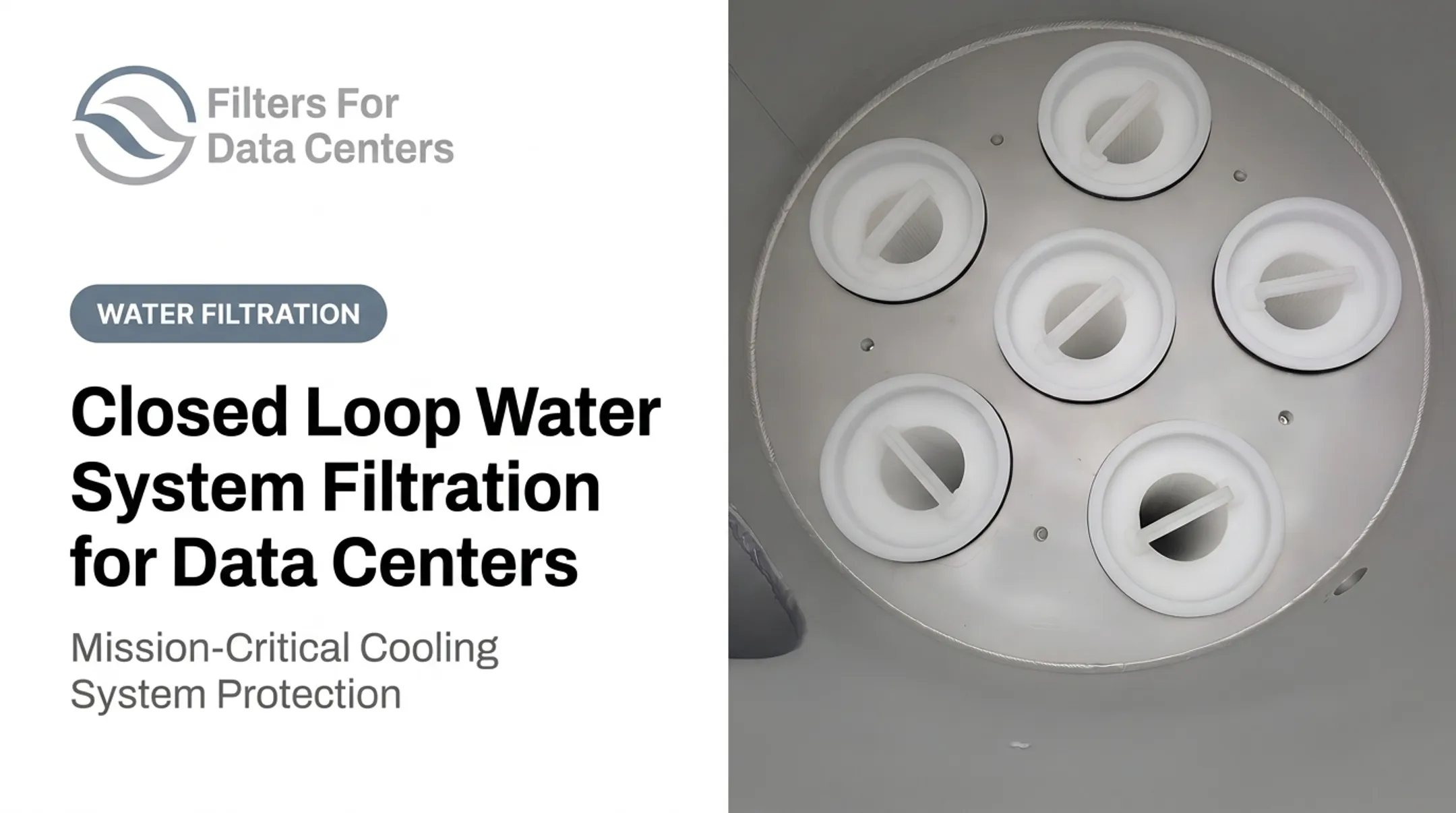
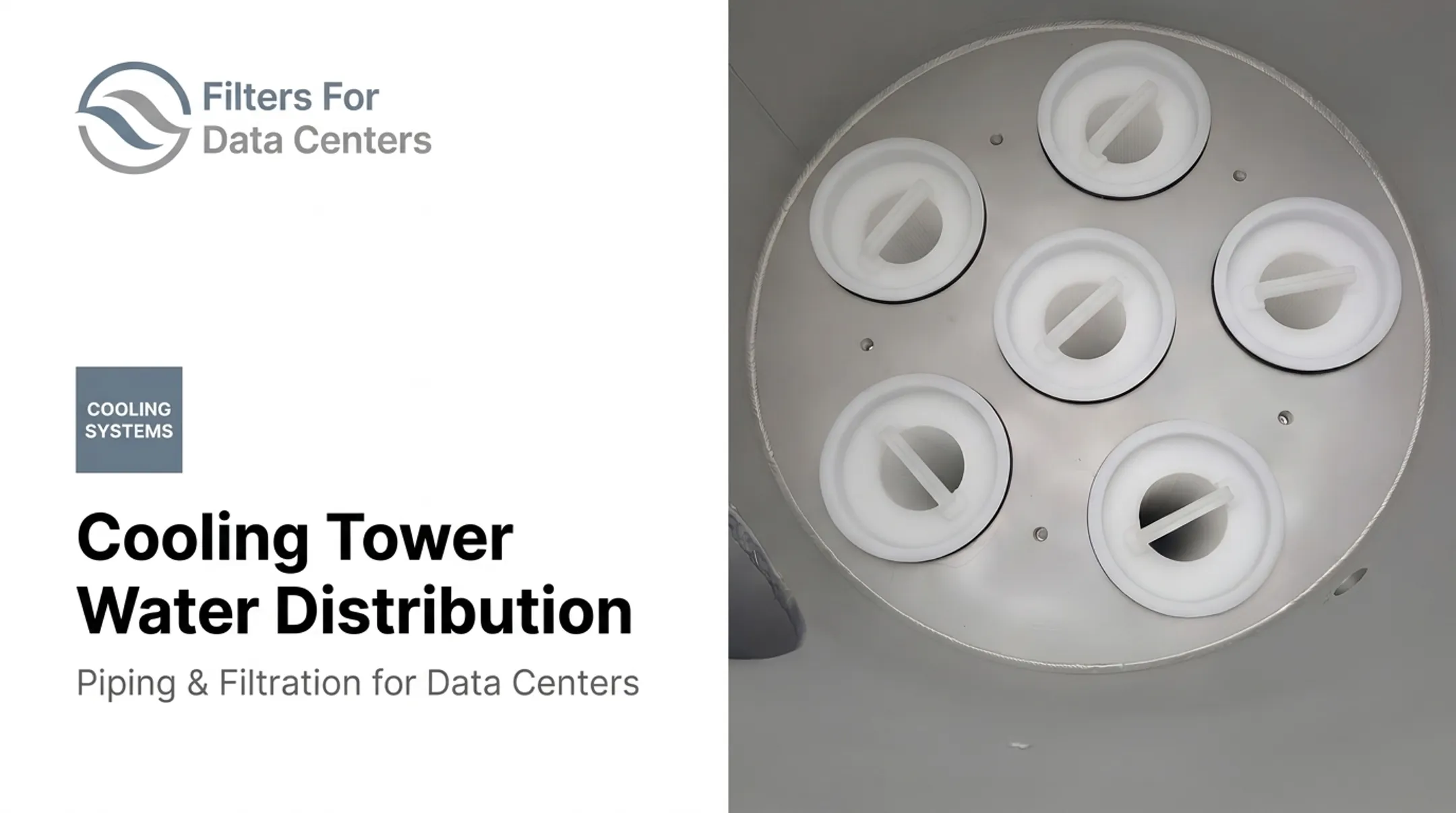
That lineup includes simplex strainers rated to 200 psi and duplex units built for continuous duty. High-flow cartridges in 20-, 40-, 60-, and 80-inch lengths can replace multiple standard 10-inch cartridges in a single housing.
Full-Flow vs. Sidestream Filtration
| Approach | How It Works | Best Fit |
|---|---|---|
| Full-flow | Filters 100% of recirculating water on the pump-discharge side | High solids loads or strict water-quality targets |
| Sidestream | Continuously filters a portion of flow, returning treated water to the basin | Lower pressure drop, ability to stay online during cleaning |
Neither approach is universally better. It depends on your solids load, allowable pressure drop, and how much flow interruption your operation can tolerate. Verify sizing recommendations against your tower and water-treatment manufacturer documentation before finalizing a design.
Filtration is one piece of a larger water-management program. Blowdown controls mineral concentration, makeup-water quality sets your starting point, and chemical treatment manages scale, corrosion, and biological growth. Routine testing (conductivity, pH, and the parameters your treatment provider specifies) tells you whether the system is holding steady.
What to monitor:
- Differential pressure across strainers, filters, and coils
- Flow rate compared to design specs
- Basin cleanliness and nozzle distribution
- Conductivity or other indicators your treatment provider recommends
- Fan status and overall cooling performance trends
Where Air-Intake Filtration Fits
Everything above addresses the water side. External air-intake filtration is a separate layer that cuts dust, pollen, cottonwood, and insects before they reach outdoor coils and air paths near the tower. It doesn't purify condenser water or replace chemical treatment, but it does reduce how hard the water-side system has to work.
This is where Data Center Filters and its Air Filter Factory division focus their support: custom external air-intake filtration sized to a specific coil or tower opening, with on-site measurement, installation, and maintenance through AFF Field Services. It complements condenser-water filtration and treatment—it does not replace either.
How to Select a Filtration Strategy for a Data Center
Start with a site assessment. Document:
- Cooling tower type and configuration (open or closed-circuit, crossflow or counterflow)
- Flow rates, basin, and piping arrangement
- Tower location, nearby vegetation, construction activity, and seasonal debris patterns
- Existing filtration or water-treatment equipment already in place

Separate the contaminants you're targeting. Large debris, suspended solids, biological growth, scale, corrosion products, and airborne material each need a different control method. Solving all of them with one filter type usually leaves one category overprotected and another exposed.
Evaluate hydraulic and operational requirements:
- Allowable pressure drop and required flow rate
- Pump capacity and filter loading rate
- Bypass arrangements and isolation capability
- Access needed for routine cleaning
- What happens operationally if a filter blocks
Build for mission-critical resilience. A filter change should never turn into a cooling outage. Plan for:
- Parallel units in duty/standby arrangements
- Isolation valves and bypass protection
- Spare elements on hand
- Remote differential-pressure alarms
- Maintenance procedures that keep required cooling capacity online during service
Duplex strainers illustrate this well: the dual-chamber design lets one basket stay in service while the other is cleaned, so filtration continues without a shutdown.
Specify for the environment. Outdoor equipment needs corrosion resistance, UV tolerance, weather protection, and compatibility with treatment chemicals already in the loop. Strainer baskets and housings built in 316 stainless steel, with mill, polished, or passivated finishes, hold up better against aggressive makeup water than lower-grade alternatives.
Require documentation and verification. Before signing off, request:
- Submittals with flow and pressure-drop data
- Recommended maintenance intervals and replacement-part lead times
- Commissioning records and baseline readings
- A clear division of responsibility among the tower manufacturer, water-treatment provider, mechanical contractor, and facility team
That last point avoids the most common failure mode in filtration programs: everyone assumes someone else is watching the gauge.
Installation, Inspection, and Maintenance Planning
Installation That Preserves Access
Filtration equipment only helps if someone can service it. Installation should keep strainers, filter housings, basins, nozzles, fill, fans, coils, and differential-pressure instruments reachable without tearing apart half the mechanical room. Where lockout/tagout or confined-space entry applies, follow OSHA requirements. A cooling tower with exposed fan blades, belts, or pulleys can qualify as a permit-required confined space.
A Routine Inspection Sequence
A consistent walkthrough catches problems before they become outages:
- Check pressure drop across strainers, filters, and coils
- Confirm filter loading and bypass valve position
- Inspect basin water and strainer condition
- Review nozzle distribution and fill fouling
- Note fan airflow, visible corrosion, and unusual vibration or temperature
Timing: Trends, Seasons, and Events
Set cleaning and replacement intervals from operating data—differential-pressure trends, basin condition, and manufacturer limits—not a fixed calendar date. A tower in heavy pollen season needs different attention than the same tower in December. High-flow filter cartridges typically call for change-out around 30 psi differential pressure. Watching that number beats a generic monthly checklist. Add inspections after pollen season, cottonwood release, wildfire smoke, nearby construction, severe weather, or any prolonged shutdown. Outdoor air intakes and tower airflow paths take the brunt of these events, so inspect them directly—not only the gauge.

Coordinating the Work
Schedule filtration work around planned maintenance windows, redundant cooling capacity, water-treatment visits, and controls alarms. Emergency procedures should also cover a filter taken offline. When fouling keeps recurring, document and close it out:
- Identify the source
- Confirm whether it is airborne or water-side
- Adjust treatment or filtration
- Validate the fix with qualified personnel before closing the work order
Frequently Asked Questions
What does condenser water mean?
Condenser water is the water that circulates between a water-cooled chiller's refrigerant condenser and a heat-rejection device, usually a cooling tower. It's separate from chilled water, which carries heat away from the building's cooling load.
Does condenser water go to a cooling tower?
In most water-cooled systems, yes. Condenser water travels from the chiller to the cooling tower and returns after heat is rejected to the atmosphere. Some facilities use dry coolers or other heat-rejection equipment instead.
How do cooling towers cool water?
Warm water contacts moving air inside the tower, and a small portion evaporates. That evaporation removes heat from the remaining water, which returns to the condenser noticeably cooler than it arrived.
What is the difference between condenser-water filtration and air-intake filtration?
Condenser-water filtration and strainers remove suspended solids and debris from the water loop itself. Air-intake filtration keeps dust, pollen, and insects out of the airflow reaching coils and towers. Neither replaces the other.
How often should a data center cooling tower filtration system be inspected?
It depends on tower design, water chemistry, contamination load, and season. Base inspection frequency on differential-pressure trends and manufacturer or water-treatment-provider guidance rather than a fixed universal schedule.