
Introduction
Sediment, scale, corrosion products, and biological growth don't announce themselves. They build up quietly inside heat exchangers, coils, pumps, and valves until a cooling system starts underperforming or fails outright.
For data centers, that failure mode is expensive. ASHRAE Technical Committee 9.9 identifies particulate buildup inside plate heat exchangers as a direct reason endpoint filtration is required at the CDU supply, with similar protection recommended on the secondary side of the cooling loop.
Cylinder type water filters are one of the most common tools for managing that risk, but picking one isn't about grabbing the largest cartridge or the smallest micron rating on the spec sheet. The right filter has to match your water chemistry, your flow requirements, your pressure limits, and what you're actually trying to protect.
This article walks through what a cylinder type water filter is, what to check before you buy one, and where to get help evaluating your cooling-water protection strategy.
Key Takeaways
- Filter shape doesn't set performance; media, micron rating basis, and housing design do.
- Test water before you buy filters—particulate media won't fix dissolved-chemistry problems.
- Size to pressure drop and flow limits, not micron rating alone.
- Use duplex housings, DP gauges, and spare elements so a changeout doesn't become an outage.
- Plan water filtration and air-intake filtration as separate protections, not interchangeable ones.
What Is a Cylinder Type Water Filter?
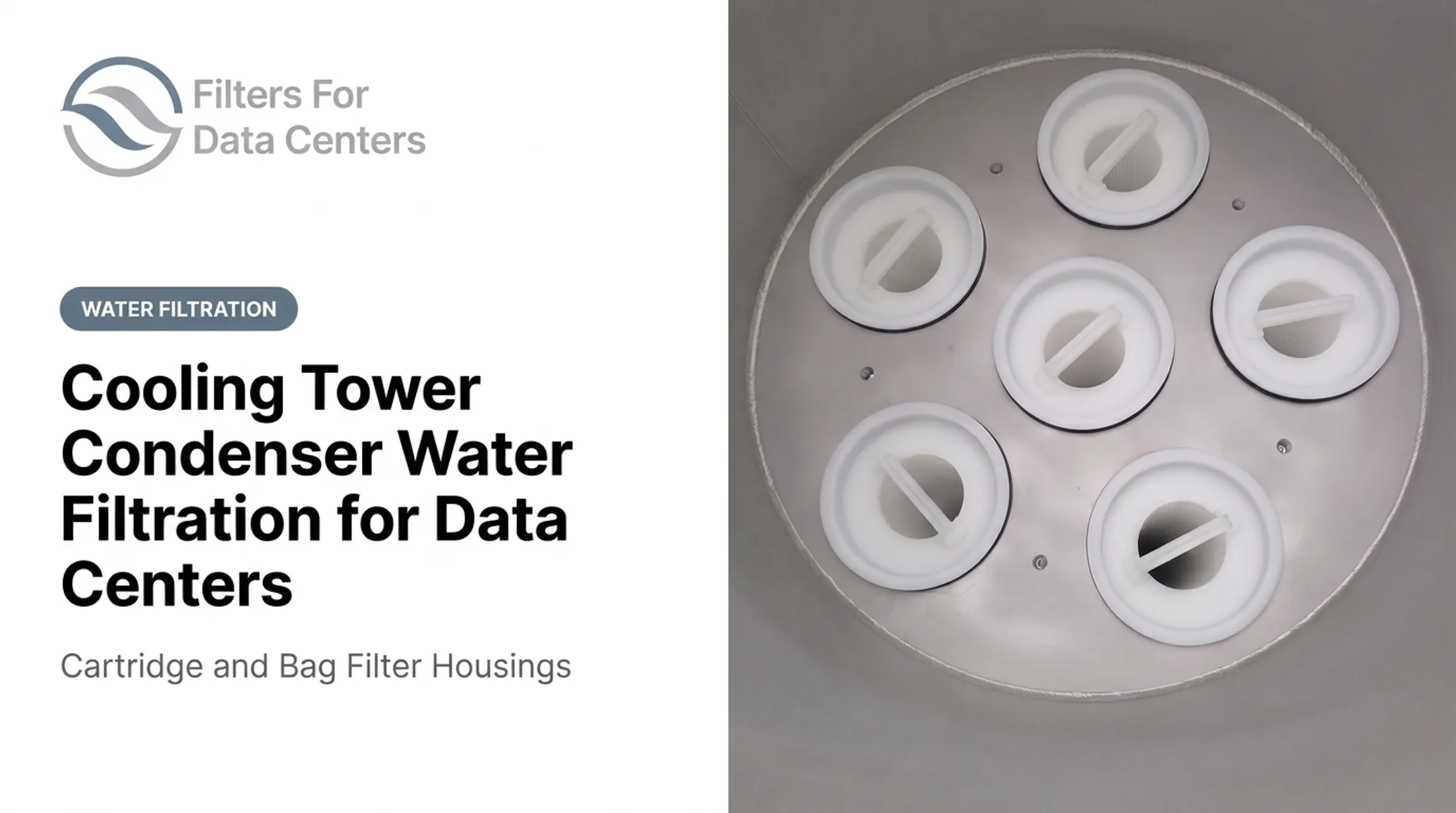
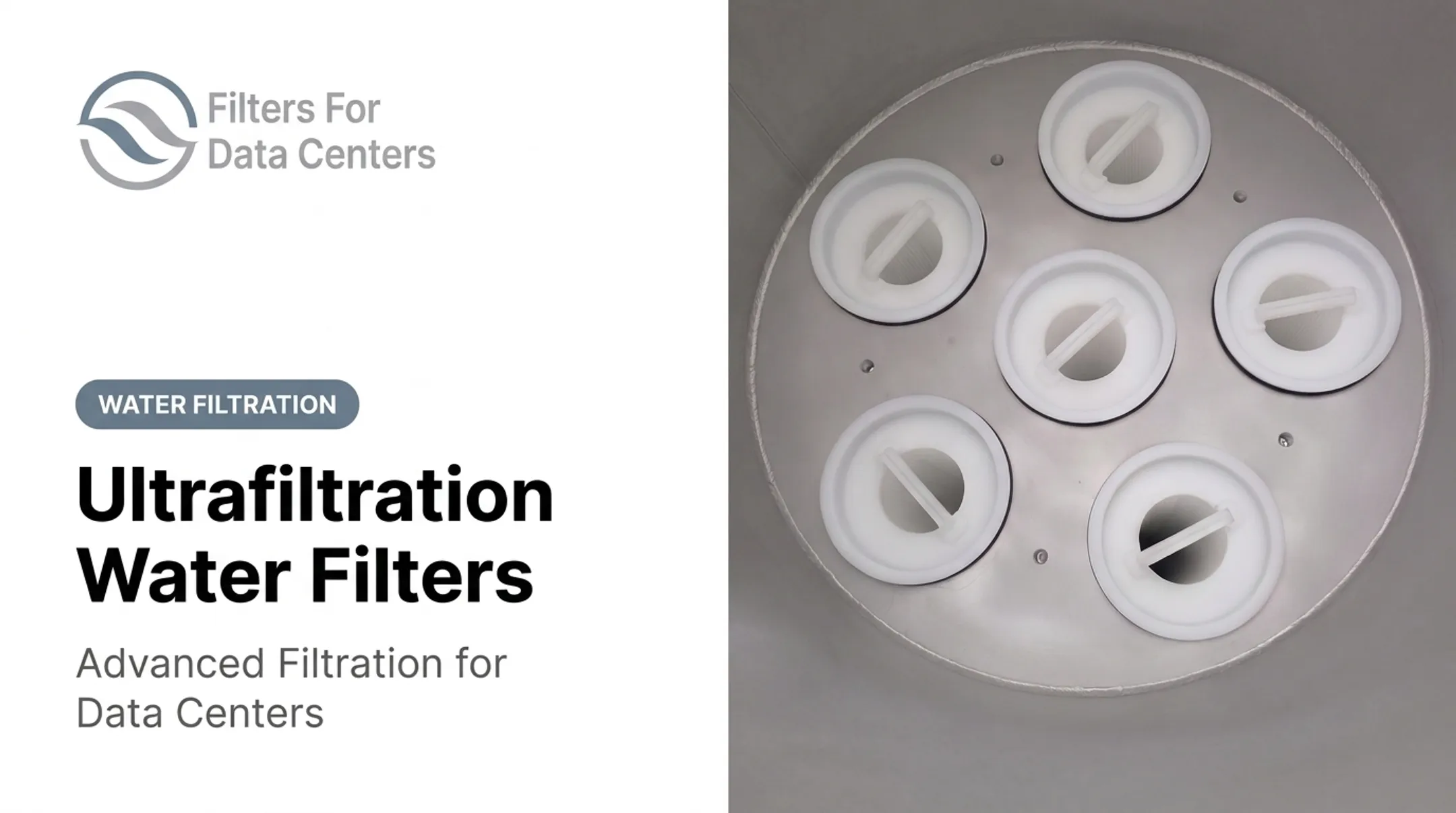
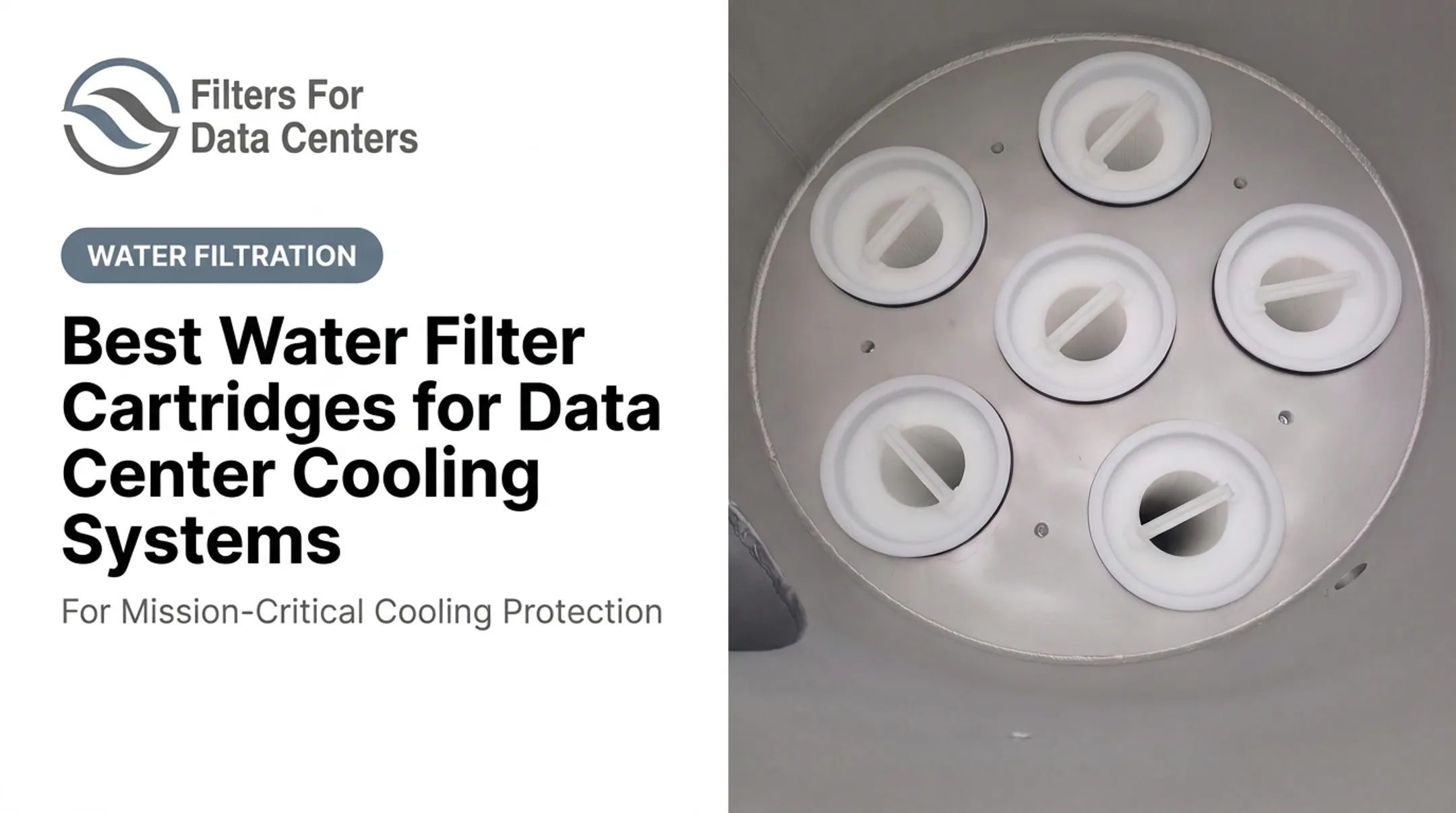
A cylinder type water filter is a replaceable cylindrical cartridge that sits inside a housing and forces water through a filtration medium to catch targeted contaminants. The name describes the shape; media, ratings, and system design determine what it actually removes.
Three parts of the assembly often get mixed up:
- The cartridge — the replaceable element with its media, core, cage, and end caps.
- The housing — the pressure vessel the cartridge sits inside, which handles connections, seals, and mounting.
- The full filtration skid — the complete assembly, sometimes including pumps, flowmeters, and pre-piping.
Mixing these up leads to mismatched expectations. A housing rated for 16 cartridges doesn't mean every cartridge inside it is doing the same job, and a cartridge alone can't tell you anything about your system's pressure containment or piping compatibility.
Cylindrical filters show up across a data center's water systems: cooling-tower side streams, makeup water lines, closed-loop protection, and pretreatment ahead of reverse osmosis. Which application it's suited for depends entirely on your system design and a current water analysis, not the cartridge's marketing name.
Core Components of a Cylinder Type Water Filter
The housing, end caps, seals, and connections do more than hold the cartridge in place. They determine pressure containment, leakage risk, service access, and whether the assembly will even fit your existing piping.
Media types vary by contaminant target:
- Mechanical sediment media — captures suspended solids like sand, silt, and clay.
- Pleated or depth media — offers different tradeoffs between dirt-holding capacity and pressure loss.
- Activated carbon — an adsorption medium for select organic compounds, not general particulate control.
- Specialty adsorption or ion-exchange media — targets specific dissolved constituents.
- Membrane elements — used where sub-micron separation is required.

Micron ratings aren't standardized across the industry the way many buyers assume. According to WC&P's review of cartridge filter ratings, a nominal rating typically reflects around 85% rejection at the stated micron size, while an absolute rating implies roughly 99.9% rejection.
Manufacturers don't apply identical test methods, so always get the test basis before comparing two "5-micron" cartridges from different vendors.
Beyond media, the functional assembly includes flow direction, rated capacity, pressure drop curves, bypass arrangements, isolation valves, and differential-pressure monitoring. A particulate cartridge protecting a heat exchanger from suspended solids solves a completely different problem than a membrane or chemical-treatment stage addressing dissolved minerals. One cartridge, in most systems, will not solve every water-quality issue on its own.
Benefits of Cylinder Type Water Filters for Data Centers
Particulate removal has a direct link to equipment protection. Suspended solids and biological deposits can restrict flow and cut heat transfer efficiency.
The Buckman Cooling Water Handbook notes that scale deposits and biofilms both interfere with heat transfer, and biofilms can progress to plugging entire flow paths.
A correctly sized filter, paired with a properly managed water-treatment program, supports more stable flow and heat transfer. That's a conditional statement on purpose: sizing and chemistry both have to be right.
Operational advantages:
- Modular cartridge replacement without shutting down the whole loop
- Easier visual inspection of contaminant loading between services
- Scalable capacity through parallel or staged housings
- Flexibility to add finer polishing stages downstream of coarser prefiltration
Be skeptical of any vendor quoting a specific percentage for energy savings, extended equipment life, or ROI tied to a filter alone. Those numbers require system-specific testing. If a claim doesn't come with documentation behind it, treat it as marketing, not engineering.
What to Consider When Choosing the Best Cylinder Type Water Filter
Filter selection should tie technical specs to outcomes you can actually measure: cooling stability, pressure control, maintenance workload, water quality, and how much operational risk your facility can absorb.
Before requesting quotes, document:
- Water source and loop type (open cooling tower, closed chilled loop, glycol-treated, etc.)
- Treatment chemicals currently in use
- Operating temperature and flow profile, including peak demand
- Contaminant history from past inspections or fouling events
- Cooling-equipment manufacturer requirements
Water Analysis and Target Contaminants
Lab testing and historical trend data come first. Media selection should never come before the water analysis. Cooling water can carry several distinct contaminant categories, and each often needs a different control strategy:
| Contaminant Type | Typical Impact |
|---|---|
| Suspended solids (mud, sand, silt, clay) | Blocks flow, reduces efficiency |
| Hardness/scale-forming minerals | Reduces heat transfer, restricts flow |
| Corrosion byproducts | Pitting, leaks, damaged tubes and piping |
| Microbiological growth/biofilm | Fouls tubes, restricts heat transfer |
| Oil and organics | Reduces heat transfer, feeds microbial growth |
Side-stream filtration removes solids, but it doesn't change the chemical composition of the water. If your analysis shows hardness, dissolved metals, or active biological growth, filtration is one piece of a larger program that likely also needs softening, biocide dosing, or reverse osmosis.
Ask any cartridge vendor exactly which contaminants their product is independently tested to reduce, and get that in writing.
Flow Rate, Capacity, and Pressure Drop
Peak and minimum flow, available pump head, and allowable pressure drop all affect how a filter performs once it's actually loaded with contaminant, not just on day one.
Metrics worth comparing across vendor quotes:
- Clean pressure drop at your actual flow rate
- Terminal pressure drop (the point that signals changeout)
- Rated flow versus your system's peak demand
- Dirt-holding capacity, tested under comparable conditions
- Service interval and required safety margin
High-flow filter cartridges used in cooling-water applications carry a maximum operating differential pressure of 60 psi (4 bar) at 70°F, dropping to 35 psi (2.4 bar) at 176°F, with a recommended changeout point of 30 psi. That temperature-dependent derating shows why pressure limits can't be treated as a single fixed number.
A finer filter isn't automatically the better choice. If it clogs faster than your maintenance schedule can handle, or drops pressure below what your cooling equipment needs at peak load, you've traded one problem for another.
Media, Micron Rating, and Configuration
Surface, depth, pleated, carbon, and membrane configurations each trade off particle capture against pressure loss, cost, and how complex the replacement process is.
- Surface media catches particles right at the outer layer — easy to inspect, but can clog faster under heavy loading.
- Depth media captures particles throughout the structure, generally offering more dirt-holding capacity.
- Pleated designs increase surface area within the same cartridge footprint, often lowering initial pressure drop.
- Carbon and specialty media target adsorption or ion-exchange needs, not general particulate control.
Where contaminant loading is high, or where continuity of service really matters, staged filtration or parallel housings often outperform a single very fine cartridge. A coarse prefilter ahead of a finer polishing stage extends the life of the expensive fine element considerably.
Don't lock in a micron rating before you have water-test results and equipment requirements in hand.
Cartridges rated for absolute removal (often around 98% at a stated size) suit polishing applications where most solids are already gone. Nominally rated cartridges, typically in the 60%, 90%, or 95% efficiency range, work better for higher-loading applications where an absolute cutoff isn't necessary.
Materials, Compatibility, and Environmental Conditions
Cartridge media, seals, housings, and fittings all need to tolerate your actual water chemistry: biocides, corrosion inhibitors, glycol if used, and whatever cleaning chemicals your facility runs.
Confirm before purchase:
- Chemical compatibility with treated water and any glycol additives
- Temperature and pressure limits under your actual operating range, not just standard conditions
- Suitability for outdoor or mechanical-room environmental exposure
- Manufacturer documentation on material composition and applicable installation standards
Seal material matters more than people expect. EPDM, FKM, and silicone options each hold up differently depending on temperature and the specific chemicals in your loop.
Request written compatibility confirmation for your exact treatment chemistry rather than relying on a generic compatibility chart. Concentration and temperature both affect real-world resistance.
Reliability, Redundancy, and Monitoring
Duplex or parallel housing arrangements, isolation valves, bypass controls, and differential-pressure alarms reduce the odds that a routine filter change turns into an unplanned cooling interruption.
ASHRAE recommends tracking both flow and pressure together, since the ratio between them can shift from reduced flow, increased pressure drop, or both changing at once. The same guidance suggests daily monitoring at startup, tapering to weekly and then monthly checks as the system proves stable.
Practical KPIs to track:
- Cooling-water inlet and outlet pressure
- Differential pressure trend over time
- Flow stability under varying load
- Alarm response time
- Maintenance duration per changeout
- Unplanned work orders tied to filtration issues
Any changeout procedure needs a documented bypass plan, and that bypass must not undermine your water-quality requirements while the change is in progress. Bypassing filtration to keep flow moving during a swap is sometimes necessary, but it shouldn't become a habit that erodes protection over time.
Total Cost of Ownership and Maintenance Planning
Purchase price is the smallest piece of the real cost. Factor in:
- Housing and installation
- Replacement elements and disposal
- Labor and water-treatment coordination
- Energy impact from pressure loss
- Testing and monitoring overhead
Build a replacement schedule around differential pressure and water-quality trends, not a fixed calendar date. A facility running cleaner makeup water might get far more service life out of an element than the manufacturer's generic interval suggests, while a facility with higher fouling risk might need changes far sooner.
Before startup, run through a commissioning checklist:
- Record baseline pressure and flow at clean-element condition
- Inspect for leaks at every connection point
- Pull water samples for baseline testing
- Verify alarm and differential-pressure indicator function
- Document installation details and completed operator training
- Schedule a post-installation performance review

How Data Center Filters Can Help
Data Center Filters helps mission-critical sites protect cooling water with high-flow cartridge systems for cooling towers, chilled loops, and RO pre-filtration. Part of the Air Filter Factory family, the U.S.-based, family-owned manufacturer and distributor was founded in 2009 in Wakeman, Ohio.
Cooling-water lineup highlights:
- High Flow Filter Cartridges in 0.5–100 micron ratings; 20-, 40-, 60-, and 80-inch lengths with a 6-inch OD
- Polypropylene media with EPDM, E-FKM, FKM, or silicone seals under an ISO 9001:2015-certified quality system
- ClearFlow housings for 1–16 cartridges in 304/316 stainless or non-metallic fiberglass, ASME Code design, optional U and CE stamps
- Up to about 210 GPM (800 L/min) per cartridge, with parallel housings when facilities need more capacity
For hardness, dissolved metals, or biological dosing issues, keep a qualified water-treatment provider involved. Particulate filtration alone does not fix water chemistry.
Air Filter Factory also covers a related air-side risk: cottonwood, dust, insects, and leaves that foul outdoor coils and cooling gear.
Support across both lines includes custom sizing and fabrication, nationwide measurement, installation and maintenance through AFF Field Services, direct human customer support, and a 5-year warranty on documented filtration systems.

Conclusion
Choose a cylinder type water filter on evidence, not the smallest micron number on the label. Fit depends on:
- Site water data
- Verified performance documentation
- Correct hydraulic sizing
- Compatible materials
- A maintenance plan matched to your facility's risk tolerance
The goal is protecting the right equipment without excess pressure loss or an unmanageable replacement burden. Review water quality, differential pressure, flow, and filter condition on a regular schedule.
Treat water filtration and external air-intake filtration as two parts of the same protection strategy, not interchangeable line items.
Frequently Asked Questions
What is a cylinder type water purifier?
It's a cylindrical cartridge or housing-based filtration unit that removes targeted contaminants from water as it passes through. The cylinder shape alone doesn't determine performance — the media and treatment objective do.
What are the three main types of water filters?
For industrial cooling systems, the practical categories are mechanical/particulate filtration, adsorption or specialty-media filtration, and membrane filtration. Many real systems combine two or more of these stages rather than relying on just one.
Are cartridge filters suitable for data center cooling systems?
Yes, when flow rate, pressure drop, water chemistry, and contaminant loading have all been verified by a qualified designer. Cartridge filters excel at targeted particulate removal but aren't a substitute for chemical water treatment.
How do I choose the right micron rating for a water filter?
Base it on water-test results, equipment manufacturer requirements, documented filter efficiency data, and your system's hydraulic limits. Don't default to the smallest micron number just because it's available.
How often should data center water filters be replaced?
Replacement timing should follow differential-pressure trends, contaminant loading, and water-quality data rather than a fixed calendar schedule. Manufacturer changeout limits and your facility's maintenance program should guide the final interval.