
Introduction
A chilled water loop rarely gets much attention until it fails. When it does, the ripple effects hit everything from CRAH units to server racks.
Data centers now account for roughly 2% of total U.S. electricity consumption, and cooling alone can consume up to 40% of a facility's energy use, according to the U.S. Department of Energy.
Many facilities managers struggle with unplanned strainer cleaning, rising pressure drop, and pump wear that traces back to a single overlooked component.
Chilled water strainers are compact components with outsized impact. They sit ahead of pumps, heat exchangers, control valves, and coils, and they control how much debris those parts ever see.
This article breaks down what strainers actually do, how they differ from filters, what happens when they're neglected, and how to select and maintain the right one for your cooling loop.
Key Takeaways
- Strainers capture larger debris before it damages pumps, heat exchangers, and valves.
- Filters and strainers serve different purposes; picking the wrong one hurts flow or protection.
- Differential-pressure monitoring and cleaning logs turn contamination risk into a manageable task.
- A bypassed or torn screen can be just as dangerous as a clogged one.
- Strainer care works best as part of a broader water-treatment and maintenance program.
What Are Chilled Water Strainers? (Brief Context)
A chilled water strainer is an inline device with a screen or perforated element that catches suspended solid debris as water moves through the cooling loop. It's mechanical filtration, plain and simple: water passes through, particles get trapped, clean water continues downstream.
Strainers typically sit upstream of:
- Pumps and heat exchangers
- Chillers and control valves
- CRAH or air-handler coils
- Flow meters and other flow-sensitive components
Strainers are not a substitute for water treatment. They address physical debris such as construction residue, rust, and scale fragments. They don't replace chemical treatment, system flushing, air and dirt separation, or fine filtration where those are actually needed.
Common Strainer Configurations
Different designs suit different operational needs:
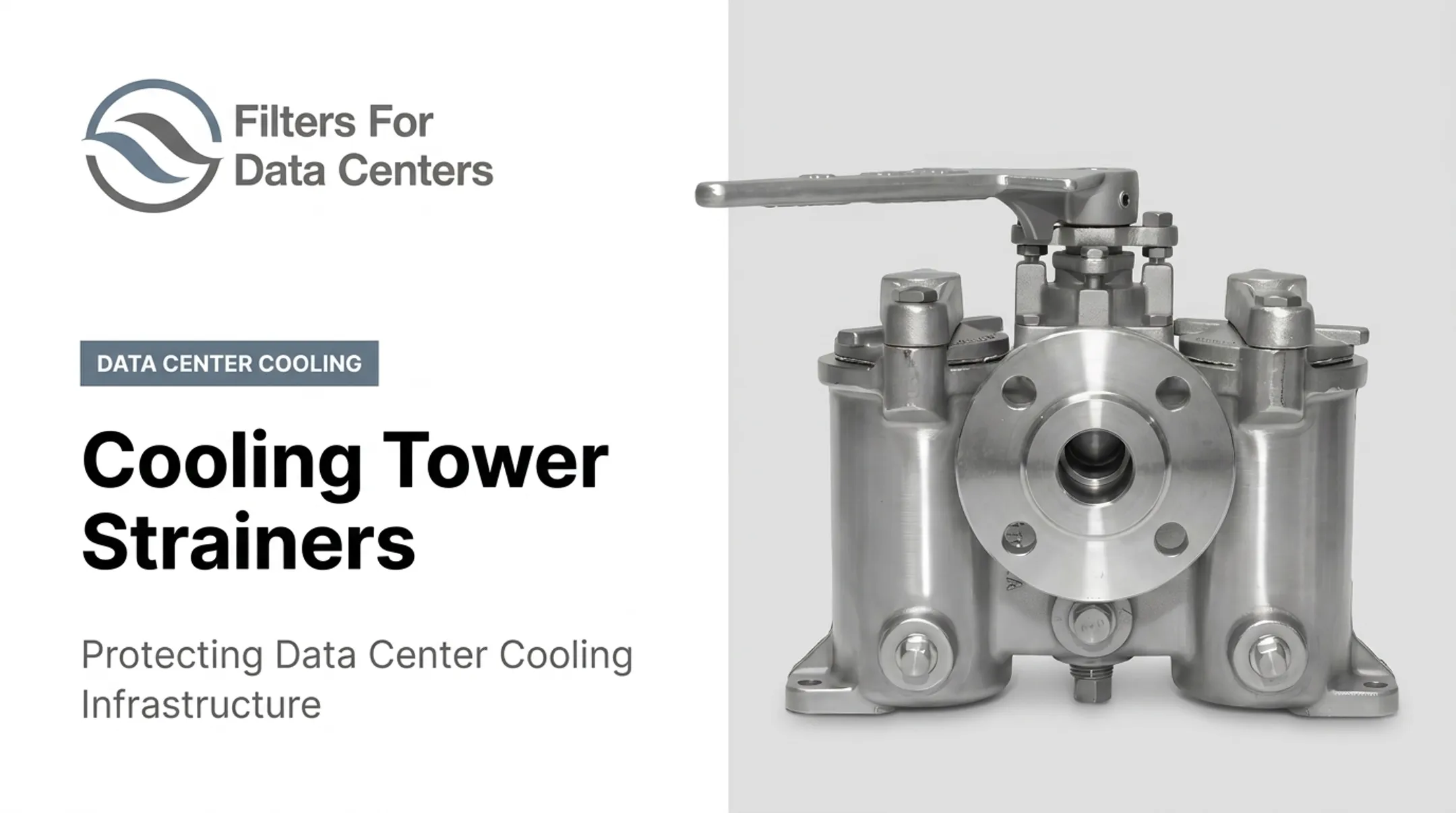
- Simplex strainers use a single basket and require a brief flow interruption for cleaning.
- Duplex strainers use two chambers, so one basket stays active while the other gets cleaned. This matters in facilities that can't tolerate a flow interruption.
- Basket strainers offer more surface area than a comparable Y-strainer, which extends the interval between cleanings.
- Self-cleaning strainers automate debris removal, though application limits vary by manufacturer.
The right choice depends on flow rate, contamination load, redundancy requirements, and how much maintenance access the site actually has. Simplex units commonly range from 3/8 to 8 inches, with perforation options from 1/32 to 3/4 inch or 20 to 400 mesh.

Key Advantages of Chilled Water Strainers
Chilled water strainers prove their value in operating results, not generic filtration claims. Here’s how they protect cooling performance in a data center.
Protect Pumps and Heat Exchangers From Debris
Solid particles enter chilled water loops constantly, whether from construction activity, repairs, corrosion, or make-up water events. Left unchecked, that debris travels straight toward pumps and heat-transfer surfaces.
A properly selected strainer intercepts larger contaminants before they:
- Erode pump impellers and seals
- Obstruct narrow flow passages
- Foul heat exchanger plates or tubes
This protection shows up in pump condition, heat-transfer efficiency, flow stability, and fewer unplanned maintenance events.
Maintain Flow and Support Cooling Efficiency
There's a real trade-off in strainer selection. Too coarse, and damaging debris slips through. Too fine, and the screen clogs fast, restricting flow and forcing pumps to work harder.
ASHRAE is direct on this point: selecting a finer strainer increases protection but also increases restriction and energy penalty. In a closed loop after startup, a very fine mesh may serve little purpose at all, according to ASHRAE's Journal Podcast.
Watch these indicators to know whether your strainer is helping or hurting:
- Differential pressure across the strainer
- Design flow versus actual measured flow
- Pump energy draw
- Supply-and-return temperature difference
This matters most during high-load periods, in systems with variable flow, and at recently commissioned loops where startup debris hasn't fully cleared yet.
Improve Reliability and Maintenance Planning
A strainer converts a vague contamination risk into a task you can actually schedule and track. Inspection, differential-pressure readings, and cleaning records give operations teams visibility they wouldn't otherwise have.
Duplex or self-cleaning designs reduce disruption further. Dual-basket strainers, for example, allow positive chamber isolation so one basket keeps running while the other is serviced.
Strainers support reliability, but they're not a standalone guarantee of uptime. That still depends on redundancy, water treatment, flushing, and sound emergency procedures.
What Happens When Chilled Water Strainers Are Missing or Ignored
Skip strainer maintenance, or skip strainers entirely, and debris travels freely toward pumps, heat exchangers, valves, and coils. The results aren't subtle.
Watch for these warning signs:
- Rising differential pressure across the strainer housing
- Declining flow relative to design specifications
- Abnormal pump behavior, including suction restriction or cavitation risk
- Temperature-control problems or frequent alarms
- Leaks around covers, gaskets, or seals
- Debris accumulating faster than expected

For brazed-plate heat exchangers specifically, particles large enough to bridge a flow passage can plug parallel paths entirely. Protecting those narrow passages usually means finer mesh, and finer mesh clogs faster. Without a practical cleaning method, the strainer starts restricting flow on its own.
Here's something facilities teams often miss: a damaged or bypassing screen can be just as bad as a clogged one. If the screen tears or the seal fails, contaminants pass straight through undetected. Everything looks fine on the pressure gauge while damage accumulates downstream.
Reactive cleaning cycles, unexpected component work, and reduced cooling margin all follow from this kind of neglect. The damage usually stays hidden until a pump, exchanger, or coil fails first.
How to Get the Most Value from Chilled Water Strainers
Strainer value depends on correct specification, installation, monitoring, and maintenance. Bolting a device into the pipework isn't enough on its own. Coordinate these decisions with your chiller manufacturer, mechanical engineer, and water-treatment provider.
Select the Strainer for the Actual System
Selection starts with the system's real operating conditions, not a generic mesh chart.
Evaluate:
- Design flow rate and pipe size
- Pressure and temperature conditions
- Contaminant type and expected debris load
- Screen area relative to the equipment being protected
According to Eaton's Technical Support Guide, standard perforated baskets offer roughly 28-63% open area, and screen opening should match the required particle size rather than defaulting to "smaller is safer."
Compare configurations based on real constraints:
| Design | Best Fit | Trade-off |
|---|---|---|
| Simplex | Applications tolerating brief shutdown | Requires flow interruption to clean |
| Duplex | Continuous-operation facilities | Higher upfront cost, more footprint |
| Basket | High debris-load applications | Larger, heavier installation |
| Self-cleaning | High-frequency debris with automated cleaning | Application limits vary by model |
Products like simplex strainers or Eaton's dual-basket 53BTX line illustrate this range: the former suits systems that can tolerate short interruptions, while duplex arrangements keep flow continuous during service.
Confirm mesh rating, screen material, gasket compatibility, and manufacturer pressure-drop data before finalizing a spec. Don't just copy a generic chart.
Install for Safe, Serviceable Maintenance
Installation quality determines whether maintenance stays routine or turns into a project every time.
Confirm before installation:
- Correct flow direction per the body arrow
- Accessible covers with adequate clearance
- Isolation valves on both sides of the strainer
- Drain or vent provisions
- Pressure-measurement points across the unit
Before opening any strainer housing, follow this sequence:
- Apply the site's lockout/tagout procedure per OSHA 1910.147
- Isolate the relevant loop section
- Depressurize and drain safely
- Use required personal protective equipment
- Verify conditions before opening the cover

Critical facilities should plan service around redundancy so cleaning one strainer never compromises overall cooling resilience. Document as-built location, screen specification, isolation points, and spare parts so the next technician doesn't start from scratch.
Monitor, Clean, and Improve the Maintenance Program
Differential-pressure trends tell you more than a calendar reminder ever will. Many manufacturers reference a 5-10 psi differential pressure as a common cleaning trigger, though the correct threshold depends on the specific product and application.
Track these during every inspection:
- Screen condition (tears, deformation, corrosion, bypass paths)
- Cover, seal, and gasket integrity
- Pre- and post-cleaning pressure readings
- Debris type and accumulation rate
If the same debris keeps showing up cleaning after cleaning, that signals an upstream issue. It usually points to system flushing, corrosion control, or a water-treatment review rather than simply cleaning more often.
Outdoor cooling equipment faces a separate challenge: cottonwood, dust, insects, and leaves entering through air intakes. That's a different filtration layer from chilled water straining.
Data Center Filters provides custom external air-intake filtration and AFF Field Services for measurement, installation, and ongoing maintenance. Those systems complement your chilled water strainer program rather than replace it.
Conclusion
Chilled water strainers are a first line of defense against the larger solid contaminants that would otherwise reach pumps, heat exchangers, and control valves. They're not glamorous equipment, but neglecting them creates problems that surface everywhere else in the loop.
The best results come from a few practical habits:
- Match the strainer to actual flow and contamination conditions
- Keep pressure drop within acceptable limits
- Provide safe service access for cleaning and basket changes
- Track performance over time rather than guessing
Strainer care works best as one part of a wider cooling-protection strategy, alongside water treatment, flushing, equipment monitoring, and planned redundancy. Get that combination right, and the strainer stays a quiet, reliable safeguard—not a recurring maintenance headache.
Frequently Asked Questions
What does a strainer do in a chiller?
A strainer captures larger suspended debris before it reaches pumps, heat exchangers, valves, and other downstream components. It protects equipment mechanically but doesn't remove every contaminant from the water.
What is the difference between a filter and a strainer?
A strainer typically captures coarser debris using a cleanable screen, while a filter removes finer particles. The right choice depends on your system's flow requirements and the sensitivity of downstream equipment.
Do water chillers have filters?
Chilled water systems may use strainers, filters, or both, depending on the chiller design, water quality, and what needs protecting. Plate heat exchangers, for instance, often call for a specific mesh rating recommended by the manufacturer.
What is a water chiller used for?
A water chiller removes heat from circulating water, which then carries that cooling capacity to air handlers, CRAH units, or other loads. In a data center, this loop is what keeps server rooms within safe operating temperatures.
Is a strainer needed at every component in the loop?
Not necessarily. Location, contaminant load, equipment vulnerability, and pressure-drop cost determine where strainers make sense in a closed loop.